Pages

Showing posts with label Heat Desiccated Products. Show all posts

Kunda

Kunda is a region specific heat desiccated semi-solid milk delicacy prepared in the Belgaum district of Karnataka and its neighbouring area. The origin of the product is traced to one Joshi family, which had migrated to Belgaum from Dehu area of Rajasthan and the product is being prepared since the beginning of 20th century.Now, Kunda is finding acceptance in places other than Karnataka. The colour of Kunda varies from light brown to dark brown. It has creamy taste with a characteristic nutty and caramelized cooked flavour. Kunda has a soft body and grainy texture with district greasy surface. Some organized dairies in Karnataka have also started commercial production of Kunda.


i.Composition of Kunda


The composition of market samples of Kunda collected from Belgaum, Gokak and other areas of Karnataka ranges between, moisture, 17.4 – 30.0%; fat, 5.1 – 17.2%;proteins, 5.9 – 11.3%; sucrose, 25.6 – 51.21 and lactose 5.7 – 15.9%.


ii.Method of Preparation of Kunda


Generally kunda is prepared using Dhap khoa (having about 40% moisture) as a base material. Buffalo milk is preferred for making such khoa. If khoa contains less than required moisture, raise the moisture level to about 40%. The flow diagram of a most commonly used method is given in Fig  below:
Flow diagram of preparing kunda
The method has not been adequately standardized and largely based on the experience of worker. Heating temperature and time are so maintained to obtain slightly caramelized product with small uniform grains. A little amount of water is intermittently added to prevent drying/burning of product during desiccation. In some parts of Karnataka, Jaggery is added in place of sugar.

Milk Cake

Milk cake resembles kalakand except for its colour and flavour. The colour of milk cake is more intense brown with horizontal layers of white or light brown. It has distinct caramelized flavour and large size hard grains with typical gummy texture.Though milk cake is consumed all over the country, particularly in northern parts it has more preference.


i.Composition of Milk Cake


The average percentage composition of milk cake prepared by a standard method is: moisture, 15.83; fat, 21.32; protein, 11.38; lactose, 7.67; sucrose, 40.46 and ash 2.29.


ii.Method of Preparation of Milk Cake


Milk cake is essentially prepared on small scale adopting batch method by the milk confectioners. Each confectioner has his own method based on the experience and market demands. A standard method developed for preparing milk cake of consistent quality is shown in Fig. below.
 Flow diagram for preparation of milk cake
 Flow diagram for preparation of milk cake
In the method shown above, buffalo milk having 6% fat and 9% SNF with an acidity level of 0.18% is preferred. Sugar is added @ 12% of milk at two stages, i.e. half the sugar on achieving about 2 fold concentration and the remaining half at pat stage formation. The product in hot condition (about 80-85oC) is transferred into designed aluminium trays with about 3-4 cms depth and kept at 60oC. This enables the product to remain in hot condition for a longer time so that caramelized flavour and intense brown colour is developed in the centre whereas light brown colour remains on out side. The length of the exposure to this temperature (60oC) depends on the intensity of colour required. Like kalakand, milk cake can also be prepared from Danedar khoa, but the quality of product is not as good as that obtained directly from milk.

Kalakand

Kalakand is also an important traditional milk based sweet popular all over the country. Though the chemical composition of kalakand is almost similar to burfi, the organoleptic characteristics of the two differ to a great extent. Kalakand has more distinct cooked flavour, brown colour, greasy or moist body and grainy texture as compared with burfi. It is particularly characterized by its large sized grains. So far no compositional standards for kalakand have been laid down under either in the PFA act or the BIS.


i.Chemical Composition


The gross composition of kalakand does not differ significantly from that of burfi. All those factors that are responsible for variations in the chemical composition of burfi and peda, also affect the composition of kalakand.


ii.Method of Preparation


Buffalo milk is preferred for kalakand making. However, the quality need not be as fresh as required for burfi and peda. Slightly substandard or returned milk having titratable acidity up to 0.18% (no sour flavour) can be used for making kalakand.Standardized buffalo milk (minimum 5 per cent fat and 9.0 per cent SNF) is taken in a kettle and heating started. On first boiling, 0.01 per cent citric acid, dissolved in small quantity of water, is added to the milk. If milk has developed acidity, there is no need to add citric acid. Boiling is continued with vigorous stirring and scraping till pat formation stage. At this stage, sugar @ 6-7 per cent is added to the contents of kettle and the mass is spread over the surface of kettle. Heating is discontinued at this stage and desired flavorings and chopped nuts may be added at this stage and mixed properly. Kalakand so produced is removed to suitable trays or packaging materials.

Kalakand is also prepared from Danedar khoa, as a starting material. Khoa is taken in a kettle and heated to about 70oC and sugar @ 30% of khoa is added. The mixture is blended properly. Additives, if desired are mixed at this stage. The whole mass is transferred to trays for setting and finally cut to required size and shape.

Kalajamun Pantua

i.Kalajamun


As the name reflects, it is also a khoa based sweet round in shape like gulabjamun but its colour is too dark, almost black like Jamun Fruit. It is also called as Kalajam in certain parts of India. This sweet is sold without syrup. Its method of manufacture is very much similar to that of gulabjamun with the exception that it is deep fat fried at very high temperature for longer time, which results in too dark colour. The surface of kalajamun is hard with surface crust whereas the inside is soft and granular with stuffing. Kalajamun is packaged and stored without sugar syrup.


ii.Pantua


Pantua has its origin in the eastern region of India. Its appearance is similar to gulabjamun but the ingredients used are different. The dough of pantua is made of a mixture of khoa and chhana, along with other ingredients such as maida and baking powder. According to one method it consists of chhana and khoa (40% each),maida (3%), arrowroot (3%), suji (3%), ground sugar (0.6%) and baking powder (0.3%). The method of manufacture of pantua is almost same as of gulabjamun.The ingredients are properly kneaded to form dough of smooth consistency with about 40% moisture. Spherical balls of about 12 grams are prepared and fried in vanaspati ghee at 120oC and after obtaining deep brown colour are transferred to hot sugar syrup (60oC) having concentration of 55o Brix. The composition of pantua prepared by this method and of market samples is shown in Table 3.5. Since chhana is added along with khoa, the texture of pantua has more spongy and chewy characteristics than that of gulabjamun.
Comparative chemical composition of pantua

Gulabjamun

Gulabjamun is a popular sweet prepared in all parts of India. Like other sweets, the manufacture of gulabjamun is also largely in the hands of halwais who adopt small-scale batch method. Though there is large variations in the sensory quality of gulabjamun, the most liked product should have brown colour, smooth and spherical shape, soft and slightly spongy body free from both lumps and hard central core,uniform granular texture, mildly cooked and oily flavour free from doughy feel and fully succulent with sugar syrup. It shall have optimum sweetness. It may or may not contain a piece of currant or cashewnut in the centre.


i.Gross Composition of Gulabjamun


The gross chemical composition of gulabjamun vary widely depending on numerous factors, such as composition and quality of khoa, proportion of ingredients, sugar syrup concentration, etc. The composition of gulabjamun, on the drained weight basis varies in the following range Table.
Gross chemical composition of gulabjamun
Gulabjamun is a popular sweet prepared in all parts of India. Like other sweets, the manufacture of gulabjamun is also largely in the hands of halwais who adopt small-scale batch method. Though there is large variations in the sensory quality of gulabjamun, the most liked product should have brown colour, smooth and spherical shape, soft and slightly spongy body free from both lumps and hard central core,uniform granular texture, mildly cooked and oily flavour free from doughy feel and fully succulent with sugar syrup. It shall have optimum sweetness. It may or may not contain a piece of currant or cashewnut in the centre.
 

 ii Method of Preparation of Gulabjamun


Presently gulabjamun is prepared from two base ingredients, namely khoa and gulabjamun mix powder. The former method based on khoa as main ingredient for gulabjamun making is discussed in this unit. Invariably gulabjamun is prepared by traditional method and the large scale mechanized method is used only by a few organized dairies.

a)Traditional method: This small scale batch method is adopted by milk confectioners (halwais). Dhap khoa, having about 40-45% moisture, is used for making gulabjamun. The method involves proper blending of 750 g khoa,250 g maida and 5 g baking powder to homogenous and smooth dough. Small amount of water can be added in case dough is very hard and do not roll into smooth balls. The mix should be prepared fresh every time. A piece of good quality current (kishmish) or cashewnut may be placed in the centre of dough
and then rolled into smooth balls. The balls of required size (normally in range 10-15 g) are formed from the dough and deep fried in ghee (vegetable/vanaspati)in a karahi to golden brown colour. The temperature of frying medium is maintained at about 125oC and balls take about 15-20 min for proper frying. It is necessary to turn balls up and down during frying to avoid localized burning.Subsequently the balls are transferred to 60% sugar syrup maintained at about 60oC. It takes about 30 min for the balls to completely absorb the sugar syrup.For preparing sugar syrup, equal quantities of sugar and water are boiled for about 10 min. The dirt or froth collecting on the surface of syrup is removed with a strainer. Sometimes even raw milk (about 50 ml for one litre of syrup) is added to boiling syrup for better refining of syrup.

 b) Khoa Based Sweets


Mechanized method: A new technology has been developed for industrial production of gulabjamun using an assembly-line system and is in use at Sugam Dairy, Vadodara (Gujarat). The flow diagram of this mechanized method is presented in Fig.

Khoa with 35-40% moisture is mixed in a planetary mixer with about 20% maida (bleached wheat flour) and 0.5% baking powder. The dough of homogenous consistency is prepared by sufficient blending, which can be judged by formation of smooth balls without surface cracks. In a portioning machine,the dough is divided into 8 grams portions. These dough portions are conveyed to the ball forming machine. Here balls are shaped like cylinder and are carried to a frying vat containing edible oil at a temperature of 140oC. After proper cooking, the balls are shifted to sugar syrup tank containing syrup of about 60oBrix. After proper soaking, indicated by settling of balls at the bottom of syrup, the gulabjamun balls are packaged in plastic containers along with an appropriate amount of hot syrup. Then the plastic cups are heat sealed with lids.

Flow diagram for the commercial manufacturing of gulabjamun


Peda


There are several varieties of peda and their methods of manufacture also vary from region to region depending on the consumers’requirements. Consequently, the quality of peda varies extremely. The range of variation in sensory quality of peda is given as follows:

Colour – White to light yellow to complete brown.
Flavour – Slight cooked to burnt
Texture – Soft granular
Shape – Normally round
Size – Varies from 20-30 g

Peda is more popular than all other khoa based sweets. The reason is that peda is considered to be a pure food and offered as ‘Prasad’ during religious worships in Hindu temples as well as on religious celebrations. Two types of peda, viz. plain(creamy or white colour) and brown (Lal) peda are available in market. Most of the information available in literature relates to plain peda. Normally peda is more hard and granular than burfi.

  i.Composition of Peda


The composition of laboratory prepared samples of plain peda and of market samples is given in table
Gross composition of peda
The wide variations in the composition of market samples of peda is attributed to all those factors discussed earlier for burfi, such as the type and composition of khoa,level of sugar added, extent of desiccation, type of peda and additives added.

Standards: Presently no standard (PFA or BIS) exists for peda

  ii.Method of Preparation of Peda


Different methods are used for the preparation of peda, depending on the type and scale of production, for example a) traditional method at small and large scale and b) industrial/mechanized method. The method for making brown (Lal) peda is different from these methods. All these techniques are described as below:

a)Traditional method: This method is basically identical to that of burfi preparation wherein a mixture of khoa and sugar is heated at low fire with sufficient working and kneading till desired texture is attained. Peda is normally made into round balls of about 20-25 g size by rolling between the palms. Fig. given below shows the flow diagram of a standardized batch method for making plain peda.
 Flow diagram of making plain peda by traditional method
 Flow diagram of making plain peda by traditional method
The following modifications in method of preparation of peda are made to meet special requirements.

• Sugar is added immediately after first boiling or before condensing of milk to develop more burnt and caramelized taste and grainy texture. This method is used in Katch District of Gujarat.

•  Khoa and sugar are cooked with or without ghee for a long time to obtain completely brown colour peda (Lal peda) of long keeping quality. This method is adopted in Mathura (UP) and Dharwad (MS) districts.

• For getting a white product, sugar is added to khoa and mixture heated at relatively slow heat. Sometimes sodium sulphate (Rangkat or bleaching agent) is also added for extra whiteness.

b) Industrial/mechanized method: Recently some dairy plants have undertaken preparation of peda using mechanized units and Rheon shaping and forming machine. They use a planetary mixer for admixing sugar with khoa and also other ingredients. Different steps and equipment required for this industrial method of manufacture of peda, being adopted by Sugam Dairy, Baroda are shown in Fig. In this process, khoa having about 72% TS is prepared on a continuous khoa making unit. In case, such a high total solids is un-achievable,
khoa with low TS is heated at 60oC in a steam jacketed kettle to obtain required TS. This khoa is transferred to a planetary mixer and sugar @ 30% of khoa is added. These are mixed thoroughly. Then flavouring/colouring ingredients and other additives (depending on the type of peda and market demands) are properly mixed. The peda mass is then stored at 0-4oC for about 10 hours so that the temperature of whole lot is adjusted to about 4oC. This low temperature of product is considered necessary for proper functioning (forming/shaping of peda balls) of Rheon machine. The peda balls are formed, wrapped and packed by this automatic machine.
 Flow diagram of the industrial method of peda making
 Flow diagram of the industrial method of peda making


Burfi

Burfi is a popular milk based confection in which the base material is essentially khoa. Sugar is added in different proportions and other ingredients incorporated according to the demand of consumers. Several varieties of burfi are sold in the market depending on the additives present, viz., plain mawa, pista, nut, chocolate,coconut and rava burfi. A lot of variation can be observed in physical attributes of market samples. Good quality burfi, however, is characterized by moderately sweet taste, soft and slightly greasy body and smooth texture with very fine grains. Colour,(except chocolate burfi) should be white or slightly yellowish. The shape of burfi is either square or rectangular.


i.Standards of Burfi


There is no PFA standard for burfi. BIS has recommended standards for two varieties of burfi, namely mawa burfi and other types table
BIS requirements for burfi

  ii.Composition of Burfi


The composition of market samples of burfi and that prepared in the laboratory is given in table.

Gross chemical composition of Burfi.
Large variations in the composition of market samples of burfi are attributed to several factors, such as:

– the variation in the quality of khoa used for making burfi,
– the amount of sugar added
– the type and levels of other ingredients, for example, coconut, chocolate, etc.
– extent of desiccation, that is the moisture removed from khoa during burfi making
– nature of packaging and storage conditions

Usually a very high level of sugar is added to market samples of burfi because it provides very high margin of profit.


iii. Method of Preparation of Burfi


The manufacture of burfi is mainly restricted to private traders (milk confections),although during the past decade serious efforts have been made to develop mechanized systems for organized dairies. The flow diagram of a batch method, the variables of which have been optimized in the laboratory to produce burfi of consistently good quality is shown in Fig

 Flow chart for preparation of burfi
 Flow chart for preparation of burfi
Dhap khoa made from fresh buffalo milk is desirable for making burfi. Khoa is taken preferably in double-jacketed stainless steel hemi-spherical kettle and heated upto 60oC by steam. In the traditional method shallow karahi made up of mild steel is used and heating source is kerosene oil or LPG burner. Khoa is thoroughly worked at about 60oC by a wooden ladle (long handle with flattened end). Sugar, preferably ground, @ 30% of khoa, is added. Aggressive beating of khoa and sugar is done at about 50oC to achieve a completely homogenous and smooth mass. At this stage heating is discontinued and additives may be added depending on the type of burfi.Burfi base is poured into previously greased (with desi ghee) shallow trays. The trays are left at room temperature for cooling and setting of burfi. Dressing of burfi with nuts, silver foil, etc is done at this stage. Finally pieces of required shape and sizes are cut and packaged in suitable boxes.

Khoa Based Sweets

Milk sweets are an integral part of the socio cultural life in the Indian sub-continent.These are consumed on special religious occasions, social events and at the end of our daily meals. Milk sweets offered to guests reflect an expression of the warmth of hospitality. In early Buddhist and Jain works, there is a mention that the sweets were prepared from thickened milk named as Sihakesara and Morandeka. Buddha allowed his followers to take some sweets for journeys on routes where it was difficult to get foodstuffs. In the Maurya period the sweets were prepared from concentrated milk with the addition of honey, jaggery or sugar. In the post-Gupta period (AD 750 to 1200), milk was used in various forms, such as concentrated,semi solid and in powder forms for either direct consumption or for sweet making.

It is evident from above historical evidences that the art of preparing sweets from surplus milk was developed centuries ago. In the present era in addition to religious and social needs, the milk sweets are prepared for value addition and earn profit to the traders. That is why, now their manufacture is not confined to only small confectioners (halwais), but many organized dairies and large players in the milk business have entered in this lucrative venture. Amongst the various milk sweets,khoa based sweets, namely burfi, peda, gulabjamun, milk cake, kalakand and kunda occupy more commercial significance than other sweets.

Preparation of Basundi

Basundi is a region specific product; hence its quality attributes vary from region to region. Product with a complete homogenous consistency (like sweetened condensed milk) to slightly granular with soft flakes is preferred in different regions. Accordingly the method of manufacturing of basundi differs from place to place. The general method involves open pan (shallow kettle) concentration of sweetened milk till a desired concentration (about 2 fold) is achieved. The heat treatment in presence of sugar imparts slight caramel flavour and brownish colour in the final product. A standard method has been developed for basundi preparation Fig
Flow diagram of the manufacture of basundi
Though both types of milk can be used for basundi making, buffalo milk is preferred over cow milk. The initial quality of milk should be good. It is desirable to adjust fat and SNF ratio of 0.50 for cow milk and 0.70 for buffalo milk for producing basundi of same composition throughout the year. Open pan evaporation with vigorous scraping produces basundi with granular consistency (due to denaturation of protein).However, if a homogenous and smooth consistency product is needed, the concentrated product should be homogenized at a pressure of 75 kg/cm2 and at 65oC. The product is stored under refrigerated conditions.

Preparation of Rabri

i.Traditional Method


Traditionally rabri is prepared from milk by private traders (Halwais) at a very small scale by simmering whole milk for a prolonged period and adding sugar after achieving the desired concentration. The manufacture of rabri, in fact, started by halwais (tea walla) who sit in small localities and sell milk in small lots to the nearby residents. They keep the milk in hot condition (near to boiling temperature) in a shallow karahi with heavy bottom to avoid spoilage. The formation of a thin skin(malai) on the hot milk and air interface repeatedly takes place in this undisturbed condition. When a customer comes to buy milk, halwai removes malai from the surface with a ladle to the cooler side of the karahi and sell the bottom portion of milk. This practice is continued for a long time (several hours). When the amount of milk is considerably reduced, it is boiled and concentrated to about 3-4 folds. Then sugar is added and finally the malai, which was collected on cooler side of the karahi is remixed with concentrated sweetened milk. This product is sold at an exorbitant price. Since the process is time consuming and labour and energy intensive,a very few halwais prefer to prepare rabri. Rabri prepared in this way is stored in open and shallow type of container, which leads to enormous contamination from surroundings. Because of lack of refrigeration facilities and very high cost of raw milk during summer months, many halwais refrain from preparing rabri during this season resulting in very high cost.


ii.Improved Method of Rabri Making


The consumers are increasingly becoming conscious about the quality and safety of milk based sweets. This awareness is influencing the consumer to purchase the products from the organized establishments even at higher price. These facts underline the need for standardization and mechanization of rabri to produce high and uniform quality product at large scale and to reduce the post manufacturing contamination(Fig).
Flow diagram of a improved method of rabri making
Buffalo milk is preferred for preparation of rabri because it contains higher fat content that is responsible for the formation of a thick layer of malai. Steam heating of milk is recommended because it will enable better control of temperature and prevent development of flavour defects, like smoky and burnt. After adding malai to sweetened concentrated milk, the flavouring ingredients (cardamom) and dry fruits(almond, cashew nut etc.) can be added. Rabri prepared by this method should be immediately chilled and packaged under hygienic conditions to prevent post- manufacturing contamination.


iii. Large Scale method of rabri making


Scraped surface heat exchangers (SSHE) are presently used for the continuous manufacture of khoa. Since rabri is also a heat-desiccated product like khoa, though to lesser extent, SSHE can be used for pre-concentration of milk to the solids level as of rabri. The flaky texture, which is an integral and desirable attribute of rabri and produced by adding malai, can be simulated by incorporating similar fibrous and flaky material in from of shredded chhana/paneer to this concentrated milk. The method developed on this concept has been shown in flow diagram (Fig).

Flow diagram of a large-scale method for preparation of rabri


Machanized and Continuous Methods of Khoa Making

i.Mechanized Methods


As discussed in preceding sections, traditional method of khoa making causes excessive strain and fatigue on the worker because milk has to be manually scraped and stirred continuously for long time by the worker standing near the heating source.The evaporation of moisture from milk and its subsequent condensing makes the surrounding hot and humid. To overcome these drawbacks, several mechanized systems have been developed from time to time. Most of these are broadly based on following two principles:
 
• In the first concept the agitator and scraping blades assembly is mechanically operated and the body of kettle is fixed/stationary.

• In the second principle, the mechanical scraping and agitation of milk is done indirectly by rotating the body of khoa making unit around the fixed agitator and scraper assembly.

The drawbacks of both the mechanized systems are a) they are batch type methods and b) cannot directly provide final desiccation to the khoa stage. When milk is thickened sufficiently (pasty stage), the mechanical agitation is not as efficient and some burning of milk solids occurs on heating surface. Hence, final product of desired texture is obtained by manual scraping. Out of the above two systems the one based on the principle of rotative body of the unit with fixed scraper assembly is more common among small traders in many parts of the country.


ii.Continuous Methods


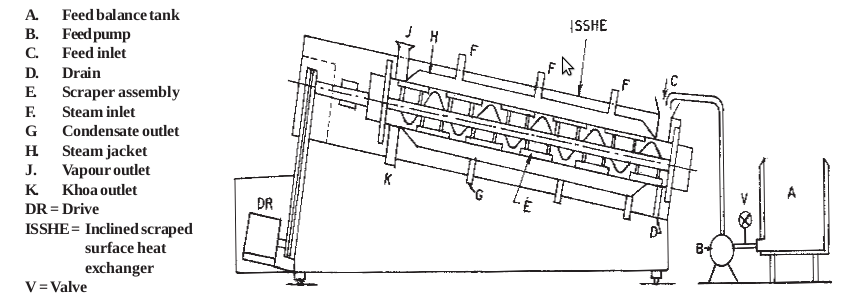
Several types of prototype machines have been designed for continuous manufacture of khoa in the past. Many of these units could not be commercially adopted by dairy industry because of some drawbacks. The most successful and presently being used are inclined scraped surface heat exchanger (ISSHE) and thin film scraped surface heat exchanger (TSSHE).Inclined scraped surface heat exchanger: ISSHE unit was developed at the National Dairy Development Board, Anand for continuous manufacture of khoa.The unit comprises of a feed balance tank, a positive displacement pump and a scraped surface heat exchanger in inclined configuration (0-30o). The feed tank is made up of stainless steel and has a capacity of 50 litres. A variable capacity feed pump is used to provide the milk concentrate to the ISSHE at the desired flow rate.The heat exchanger comprises of inner cylinder, rotor and drive, and outer steam jacket. The inner cylinder is in S.S. construction and forms the main body. It is provided with steam jacket and split into three separate compartments. The steam jacket is insulated and cladded. The design of rotor is the key factor in this innovation.It combines the functions of scraping and conveying the product. The rotor is driven by a variable speed drive. The constructional features of ISSHE are shown in
ISSHE Continuous Khoa Making Plant

Concentrated milk having 40-45% total solids is pumped into the inlet of the ISSHE at the desired flow rate by adjusting the capacity of the feed pump. At the start of the operation, the inclination of ISSHE permits formation of a pool of boiling milk,critical for development of desired heated or slightly cooked flavour in khoa.Subsequently, fresh concentrated feed enters the pool of boiling concentrates, while an equivalent mass continuously leaves the pool as semi-solid mass (khoa). The scraper repeats the process of removing coagulated particles from the heat transfer surface and mixing them back into the pool of heated milk. The coagulated particles absorb milk resulting in the agglomeration and formation of characteristic khoa texture. The inclination of the scraper provides interface between metal, milk and air, which enhances the heat coagulation of proteins which is essential for simulating desired flavour and texture in khoa. The process of khoa making as it takes place in a karahi is replicated in the ISSHE. The wet coagulated particles are pushed ahead by the screw conveyer. At the end of the process run, supply of concentrated milk is
stopped and warm water is circulated. It can produce about 40 kg khoa per hour,but installing more such units can increase the capacity.

Thin film scraped surface heat exchanges: TSSHE unit for continuous manufacture of khoa was developed at National Dairy Research Institute, Karnal.The constructional features of this unit have been shown in Fig. 2.3. In this unit, the two SSHEs are arranged in a cascade fashion. The rotor of the first SSHE is provided with four variable clearance blades and operated at 200 rpm. Standardized buffalo milk is concentrated in this SSHE in the range of 40-45 per cent T.S. This concentrated milk then enters the second SSHE, which has a different kind of rotor arrangement.It has two variable clearance blades and two helical blades, which operate at a speed of 150 rpm. Both the SSHEs are double jacketed and fitted with steam supply line, pressure gauze and vapour outlet. Contrary to the ISSHE, the cylinders in this unit are placed horizontally, one after the other. Milk is fed into first SSHE with a centrifugal pump, whereas, the concentrated milk from first SSHE to second SSHE moves by gravity. It can produce about 50 kg of khoa per hour
Thin Film Scraped Surface Heat Exchanger for Continuous Khoa Manufacture

 Advantages of continuous khoa making plants


• As the process is continuous, the product of uniform quality with low operation losses is produced throughout the run.
• Higher heat transfer coefficient, so fuel consumption is considerably less.
• It is easy to go in for automation.
• The plant is suitable for cleaning-in-place (CIP).
• Only one man can handle the unit without much fatigue.
• Sanitary operation as process takes place in a completely closed environment.


Disadvantages


• Unsuitable for small entrepreneurs
• The initial cost is high.
• Trained operator is required to run the plant.
• The ISSHE unit requires concentrated milk, having 40-45% TS as feed, hence cannot be adopted where concentrated milk is not available.

Factors Affecting Quality and Yield of Khoa

Fresh milk is usually preferred for production of good quality khoa, which has desirable organoleptic attributes and is suitable for making different types of sweets. The average yield of pindi khoa from standardized cow milk (fat 4.0% and SNF 8.6%) should be 18.5% and from buffalo milk (fat 6% and SNF 9%) 23%. The yield of other two types viz. Danedar and Dhap made from buffalo milk are usually 24% and 25% respectively. The various factors that affect the quality (here referred to organoleptic quality and suitability for sweets making) and yield of khoa are discussed as below:


i.Quality of Milk


Species of animal: Buffalo milk is preferred for preparation of khoa over cow milk due to following reasons:Organoleptic quality of buffalo milk khoa is much superior than cow milk khoa,because of its pleasantly sweet and creamy taste, soft body and texture with uniform grains. The colour of buffalo khoa is also whitish or creamy white, which is more attractive. On the contrary, cow khoa has salty taste because of presence of higher amounts of chloride (0.10% in cow milk as against 0.07% in buffalo milk) and its body is hard and dry due to low fat content. The free fat content, which provides some greasy appearance to the khoa and considered desirable attribute for sweet making, is also higher in buffalo khoa (about 60% of total fat) than cow khoa (lessthan 50% of total fat). The yield of buffalo khoa is also more as mentioned earlier because of higher total solids in it. Buffalo khoa is more suitable for making sweets than cow khoa.The organized dairy sector normally receives mixed milk. The quality and yield of khoa prepared from mixed milk falls in between that of buffalo milk khoa and cow milk khoa.

Use of colostrums: Colostrums milk has extremely poor heat stability and its chemical composition is different from normal milk. Khoa made from such milk has deep yellow colour and very big size clotted lumps unsuitable for sweets making.

Use of concentrated milk: The use of concentrated milk having more total solids requires less moisture removal for khoa making and thus exposed to heat treatment for less time. This results into lesser heat denaturation of milk proteins and under development of typical heated/cooked flavour in khoa. Therefore, khoa made from concentrated milk has somewhat bland flavour.Fat content in milk: A minimum of 4% fat in cow milk and 5% fat in buffalo milk is essential to prepare khoa conforming to legal (PFA) rules. The most pleasing aroma and taste in dairy products including khoa is attributed to butterfat. Therefore,the higher fat content in milk produces khoa of better quality not only in terms of flavour, but also the desirable body and texture. Khoa made from low fat milk possesses flat flavour and hard and dry body that lacks typical soft and mellowing characteristic.

Milk Acidity: The fresh milk produces khoa with good flavour and texture. Pindi khoa can only be made from fresh milk having acidity in the range of 0.14 to 0.16% as lactic acid. More than 0.17% acidity in milk produces khoa of grainy texture. The size and hardness of grains increases with the increase in acidity. However, for the manufacture of Danedar khoa, acidity upto 0.18% developed by addition of an acidulant is optimum. In addition to grainy texture, khoa prepared from high acidity milk, developed due to natural sourcing, has acidic/sour flavour. Such khoa is unsuitable for making of good quality sweets.Presence of adulterants/neutralizers: Adulteration of milk with water reduces the total solids contents of milk, thereby requiring more time for evaporation of this extra moisture to obtain khoa of desired solids. This is possible by exposure of milk to heat treatment for longer duration, resulting into development of brown colour in khoa. The yield of khoa will also be lowered in proportion to the amount of water added for adulteration of milk.

• Starch is added to milk to increase its total solids, particularly when adulterated with water. Khoa made from such milk is normally pasty with doughy taste.The yield however is higher in this case.

• Neutralization of high acid/sour milk is a regular practice in India. Use of neutralized milk produces khoa with improved texture having grains of very small size or no grains at all. But the flavour cannot be improved. Khoa made from neutralized milk has either salty or soapy or sour flavour, depending on the extent of neutralizer used and the level of souring (acidity) in milk before
neutralization. The moisture retention in khoa made from neutralized milk is higher and so also the yield.


ii. Speed of Stirring


The speed of stirring should be optimum. It depends on the type of machine/method.In case of traditional method, the optimum speed is about 100 rpm, whereas, in continuous system, it is slightly more (upto 200 rpm). The optimum speed of stirring prevents burning of milk solids and helps developing desirable body and texture in khoa. Low speed results into burning of khoa, whereas, the higher speed makes the product pasty and sticky.


iii. Temperature of Desiccation


To obtain good quality khoa, milk should be maintained at the boiling temperature till it reaches a pasty consistency and then lowered to about 95oC. Normally at this stage, the heating is discontinued. Continued heating at higher temperature at advanced stage of khoa making results in undesirable flavour (cooked) and texture (hard and dry). The colour of such product is also brown. Slow heating is not only more time consuming but also produces sandy texture and brown colour.


iv. Homogenization of Milk


Normally milk is not homogenized for khoa making. But under certain circumstances,such as use of recombined milk or for increasing the fat by adding butter oil or butter, homogenization of milk becomes essential. Khoa prepared from homogenized milk is brittle and lack cohesiveness. The moisture retention in such khoa is also more, which results into softness and higher yield.

Preparation of Khoa

i.Traditional Method


Pindi Khoa: Milk in small lots (not more than 5 litres), preferably buffalo milk is taken in an open pan (karahi) and boiled over brisk non-smoky fire. While boiling,milk is continuously and vigorously stirred with a circular motion by a ladle (khunti) to avoid burning of milk solids on the surface of the pan. Milk thickens progressively as the evaporation of moisture takes place constantly. When concentration reaches to about 2.8 times in cow milk and 2.5 times in case of buffalo milk, the thickened mass shows abrupt change of colour and consistency indicating that heat coagulation of milk proteins has started taking place. Vigorous stirring and desiccation is continued till the viscous product reaches a pasty consistency and begins to dry up. Very close attention is given at this stage. The final product is ready when it shows signs of leaving the sides of the pan and collecting in the form of a bolus. This stage is called as pat formation and invariably should be achieved after moving the pan off the fire and by working the contents up and down. The finished product is transferred to the aluminium containers of normally one kg size for molding/shaping. One batch of khoa requires about 20 minutes of complete.There are several limitations of the traditional method. Some undesirable flavours,such as smoky and burnt may also develop in khoa made by this method.

Danedar Khoa: For making danedar khoa, an acidulant (preferably citric acid @0.01 – 0.02%) is added to milk during boiling stage. It will result into earlier coagulation of milk proteins and development of large size grains needed for the manufacture of milk cake and kalakand. The rest of the method is same as for Pindi khoa.

Dhap khoa: When milk reaches to semi solid state or starts leaving the of heating surface of the kettle, heating is stopped and product is immediately taken out of the kettle. At this stage khoa is slightly loose due to higher moisture retention.


ii.Improved Method


It makes use of improved equipment (Fig. 2.1). A stainless steel jacketed kettle with steam supply is used for boiling milk. It has provision of controlling the heating by regulating steam valve, tilting mechanism, pressure valves, etc.Buffalo milk is standardized to desired fat (about 5.5 per cent) and SNF (9 percent) level so that the composition of final product does not vary. The quality of milk is also evaluated in respect of colour, flavour (sourness in particular), acidity/pH and presence of adulterants/neutralizers. Desiccation conditions in respect of temperature,speed of stirring and scraping and level of desiccation are controlled. Khoa from the heating kettle is immediately packaged and stored under sanitary conditions to prevent contamination, surface evaporation and delay spoilage.
Double Jacketed Stainless Steel Kettle for Preparation of Khoa/Basundi

Principle of Manufacture of Khoa,Rabri and Basundi

The general principle of manufacture of khoa, rabri and basundi involves desiccation or removal of moisture by heating (mainly boiling) of milk in a vessel. The vessel is either a traditional Karahi or improved double jacketed stainless steel kettle with tilting mechanism, and source of heat are wood/coal fire, LPG and steam.Milk is continuously boiled till desired concentration of solids is achieved, and more importantly till typical characteristic flavour and desired texture characteristics are developed in the final product. The proper agitation of milk and scraping of heating surface, where milk comes in contact with, are very important steps involved in manufacture of khoa, rabri and basundi.

Methods of Manufacture and Factors Affecting Quality of Products

The manufacture of khoa, rabri and basundi is largely in the hands of private traders(halwais). They use highly primitive techniques essentially based on their experience.The scale of production is too small, each batch comprising of about 4-5 litres of milk. The equipment used for manufacture of these heat-desiccated dairy products are made up of iron or cast iron or mild steel. The conventional methods used by halwais for the manufacture of khoa, rabri and basundi though are simple and cost affective, they suffer from several inherent limitations. Some of these are given as below:

• Wide variations in chemical, microbial and sensory qualities from batch to batch.
• Small scale batch processes unsuitable for commercial adoption
• Low heat transfer coefficients causing equipment to be bulky
• Unsanitary operation due to open atmospheric desiccation
• Excessive strain and fatigue on the operator
• Poor packaging
• Limited shelf life of the product

Now, the technology of these products has been standardized. In case of khoa,continuous khoa making units have also been developed, and are presently being used by many organized dairies as well as by some large private traders.

Physico Chemical Changes During Manufacture of Khoa,Rabri and Basundi

i.Changes During Khoa Making


Preparation of khoa involves three actions viz. heating, concentration and vigorous stirring and scraping. These actions cause following physico-chemical changes:

• Denaturation of whey proteins, particularly the β-Lactoglobulin and α-Lactalbumin tend to undergo varying degree of self aggregation, denaturation/coagulation as the temperature of milk rises above 77oC (90oC in case of buffalo milk) and their interaction start with k-casein as the heating temperature rises.

• The denaturation of the whey proteins results into production of sulfhydryl compounds, which produces characteristic cooked flavour in khoa and other heat desiccated products.

• Though casein is quite stable at high temperature, but the combined effect of severe heat treatment and concentration and complexing of whey proteins with it, substantially increases the size of casein micelles. This results into loss of stability of casein micelles. The coagulation of casein tends to increase logarithmically at a constant temperature of heating with milk solids
concentration.

• Coagulation of casein and aggregation of whey proteins with it entrap part of the fat in this aggregate. The moisture also disperses as fine droplets in the aggregates of proteins.

• The removal of moisture from milk results into concentration of milk solids and changes in their status, particularly proteins and minerals. These eventually change the state of milk from liquid to solid or semi solid. All the constituents,including lactic acid, increase in proportion to the degree of concentration.

• Vigorous agitation of milk at elevated temperatures during desiccation of milk disrupts the fat globule membrane releasing some fat in form of free fat (about 50% of the total fat). Formation of this free fat is very important from the flavour and texture point of view.

• The heating of milk at high temperature causes conversion of soluble calcium and magnesium to insoluble form that leads to interaction (denaturation and hydrolytic cleavage) between protein components.

• Continuous heating of milk solids at high temperature (around boiling) causes browning. This is attributed to formation of Melanoidin pigment. This browning reaction is Maillard type due to interaction between addehyde group of lactose and free amino group of casein.


ii. Changes During Rabri Making


• Rabri is not a homogenous product. Part of it is in concentrated liquid form and part in form of solid and flaky material.

• Most of the fat is present in form of flakes. The flakes are obtained by heat coagulation of proteins on the liquid air interface and its interaction with milk lipids (malai).

• Denaturation and complexing of whey proteins with casein also result due to heating and concentration of milk but to lesser degree than in khoa.

• All other changes viz. browning, lactose and mineral status and vitamin loss are similar to that in khoa.

iii. Changes During Basundi Making

• Unlike khoa and rabri, basundi is in concentrated liquid form (i.e. flowable product).

• The rate of browning is more than khoa because sugar is added to milk during boiling and the rate of Maillard reaction is more. Some caramelization also takes place.

• Denaturation of whey protein and their complexing with k-casein also take place during basundi making. But heat coagulation of casein does not appear appreciably.

• Fat is present in its native state (dispersed in aqueous phase in the form fat globules), though some free fat releases due to vigorous action of stirring and scraping.

Nutritive Value of Heat Disccated Traditional Milk Products

Khoa, rabri and basundi are concentrated forms of milk solids. In case of khoa,
sugar is not present, but in rabri and basundi sugar is added to sweeten the products for direct consumption. So, these products are rich source of energy. Pindi khoa provides about 400 kcal/100g. The values for other types of khoa, i.e. Dhap and Danedar are slightly lower. Rabri and basundi supply about 280 and 250 kcal/100 gm products, respectively. These desiccated products are also rich source of minerals,particularly the calcium. However, some losses of milk nutrients during heat desiccation may also take place. For example, about 2.6% reduction in available lysine due to interaction between amino acid group of lysine and aldehydes group of lactose (Maillard browning) take place under drastic heat treatment in khoa. In addition, about 20-25% water-soluble vitamins are also lost during khoa making.

Basundi


i.Definition


Basundi is a popular product of western and southern parts of India particularly states of Andhra Pradesh, Gujarat, Karnataka, Maharashtra, Kerala and Tamilnadu.The exact origin of basundi is not known, but it has been consumed as a milk dessert in our country for centuries. It is served during special festivities and religious occasions. Its production is mainly confined to the restaurants, hotels and individual household who adopt small scale batch method.

Basundi is also a heat desiccated, sweetened milk like rabri. The difference between the two is based on the texture. Rabri has very distinct hard flaky layers of clotted cream (malai) whereas basundi is generally homogenous or have very soft and fine flakes, which in fact are very fine heat coagulated proteins particles. Basundi has a sweetish cooked to caramelized flavour and its colour varies from white to slight brown.

Standards: So far no PFA and BIS standards exist for basundi.


ii.Composition of Basundi


The chemical composition of Basundi depends on the

Type and composition of milk
Degree of concentration of milk solids
Quantity of sugar and other additives added.

The average chemical composition of basundi is given below in table
Average chemical composition of basundi


Rabri

i.Definition


Rabri is an indigenous sweetened desiccated milk product containing distinctive hard layers (flakes) of malai (clotted cream). The product also contains some liquid portion along with the layers of malai and lumpy (semi-solid) mass. Rabri has slightly cooked aroma and pleasantly sweet and creamy taste. The colour varies from light yellow to white with slight tinge of browning depending on the type of milk used.Many additives such as cardamom, dry fruits (Kaju, Badaam, etc.) are also added to rabri to make it more delicious. Rabri is very popular in the northern and eastern regions of India and consumed directly as a milk dessert on festivals and happy occasions like marriages, birthday celebrations, etc.Standards for rabri: Neither PFA nor BIS has recommended any standard for Rabri.


ii.Chemical Composition of Rabri


Rabri is traditionally prepared by halwais. The method used by them is essentially a batch type based on their past experience. Therefore, large variation in the market rabri is expected. The average composition of rabri prepared in laboratory using a standard method and of the market samples (range) is given in table
Gross chemical composition of Rabri

iii. Factors Affecting Composition of Rabri


Like khoa, rabri is also a heat desiccated milk product but it is sweetened by adding sugar to it after desiccation. The total solids in rabri are less, which means it is not as solid as khoa. Most of the factors that affect the composition of khoa such as type and quality of milk, degree of concentration, manner of handling and packaging,storage conditions, etc. also hold true for rabri. The additional factors that affect the composition of rabri are given as below:

Level of sugar addition: Sugar is added to rabri at different levels. Addition of sugar at higher rate lowers all other milk constituents, viz. fat, protein, lactose and ash contents in rabri, whereas lower sugar rate will have opposite effect on the composition of rabri.

Addition of additives: The effect of additives, when added in substantial amounts,will be similar to that of sugar i.e. decrease in the percentage of all other constituents of rabri.

Khoa


Khoa is an important indigenous milk product. It is conventionally prepared by continuous boiling of milk in an open kettle until desired desiccation (normally 72-75% total solids) and texture is achieved. According to one estimate about 5.5% of total milk production is converted into khoa. This amount is equivalent to 3 million kgs kho/per day. Khoa is used as a base material for a variety of sweets, such as burfi, peda, gulabjamum, milk cake, kalakand, kunda etc.


i. Standard


PFA Standards of Khoa : According to PFA khoa is a product obtained from cow or buffalo milk or a combination thereof by rapid desiccation and having not less than 30% fat on dry matter basis of the finished product.BIS requirements for Different Types of

Khoa : According to BIS, khoa is a heat coagulated milk product obtained by partial dehydration of milk of buffalo,cow, sheep and goat or their admixture. It shall not contain any ingredient foreign to milk except the addition of citric acid in Danedar khoa added to develop the desirable characteristic. Three types of khoa are manufactured, viz. Pindi, Danedar and Dhap.Their requirements as per BIS are given in below table and specific characteristics as below:

Pindi: It is characterized as a circular ball of a hemispherical pat with smooth and homogenous body and texture. The grains are very small and of uniform size throughout the mass. The product possesses characteristic heated/cooked flavour. It is used for the manufacture of various varieties of burfi and peda.

Danedar: It is characterized by its granular texture and uneven body. The size of grains depends upon the amount of acidulant added and the acidity of milk used.Citric acid when added should normally be less than 0.1% (preferably 0.02%). This type of khoa is used as a base for the preparation of kalakand, milk cake and pastries where granulation is desirable.

Dhap: This type is characterized by loose and sticky body and smooth texture. It is normally pre-pindi stage and thus contains higher moisture. Dhap khoa is purposely prepared for its use in preparation of gulabjamun and pantua so that balls of smooth surface can be prepared.
BIS requirements for different types of khoa

ii Chemical Composition of Khoa


The composition of market samples of khoa shows great variation. The main reason for this variation is that manufacture of khoa is largely in the hands of private traders(halwais) who do not adopt standard practices for khoa making. The composition of khoa has been given in below table.
Gross chemical composition of khoa
*Khoa prepared from standardized buffalo milk (5.8% fat and 9% SNF) under controlled conditions.

** Khoa prepared from cow milk standardized to 4.0% fat and 8.6% SNF


iii. Factors Affecting Composition of Khoa


The large variations in the market samples are attributed to the following factors:

Type and quality of milk used: The composition of cow and buffalo milks is different in respect of total solids, fat, proteins and lactose. Therefore, the use of these milks as such or their combination (without standardization) produces khoa of different composition. Buffalo milk khoa normally contains higher moisture and higher fat levels, but lower contents of protein, lactose and ash than cow milk khoa.Adulteration of milk with water or removal of fat from milk also affects the composition of khoa.

Method of preparation: In the conventional methods, adopted by halwais and unskilled workers, the desiccation of milk is done just by their past experience,which is bound to vary from lot to lot. Removal of more moisture during desiccation leads to decrease in moisture and increase in all other solids in khoa where as the removal of less moisture has opposite effect on the composition of khoa. The use of mechanized and continuous method produces khoa of more consistent quality.

Degree of heat treatment: Higher degree of heat treatment, results into very fast desiccation of milk solids particularly at the final stage. This may reduce the moisture content to a greater extent and increase all other milk solids in khoa.

Manner of handling and packaging: Leaving khoa on the hot surface of heating kettle for a longer time in the conventional method of preparation or in the open trays in continuous khoa making process, causes more evaporation of moisture thereby changing its final composition. Improper protection/package of khoa also leads to surface drying and decrease in the moisture content.

Storage conditions: Storage of khoa in dry conditions or humid conditions,particularly when improperly protected, also results into compositional changes.The storage of khoa for longer time will have more drastic effect in these conditions.


Most Reading